

Rescue project in the Sultan's palace
Update in progress
Solution context
Today, this project is history, but its origins go back deep into the era of analog camera systems, when coaxial cables were the main transmission medium. At the time, this was a technological standard, but one that required strict adherence to physical limits.
The fundamental problem was signal attenuation, which increased in direct proportion to frequency and route length. For the transmission of high-quality colour images, it was necessary to maintain a stable bandwidth from 20 Hz to 7 MHz. Already with cable lengths of over 100 metres it was necessary to deploy corrective elements to amplify the attenuated frequencies and restore resolution. Our state-of-the-art correction separators were then able to compensate for losses even on routes of 1,200 metres.
A crisis situation arose with our partner in Malaysia. A local company with no in-depth technical knowledge had installed an incredible 1,800 metres of coaxial distribution lines there, completely without any correction. As it was for the security of the Sultan's palace, the stakes were high.
The result was tragic from a technical point of view: the monitors displayed only illegible black-and-white smudges instead of sharp images. Due to the prestige of the contract and the strictness of the local authorities, the implementation company was threatened with exemplary penalties for a malfunctioning system. It was at this point that our solution came into play, which was to push the limits of the technological possibilities of the time.
The content of the solution
The path to saving the project in Malaysia was not straightforward. It began, paradoxically, with a visit to an open-air museum of Kysuce architecture in the middle of a holiday. While the family admired the sights, I spent hours on the phone with the customer, calculating the limits of attenuation in my head.
Immediately after my return, the practical simulation phase followed. In order not to risk failure on site, we bought 3,600 meters of coaxial cable. We created two test routes in parallel to simulate the extreme conditions in the Sultan's palace.
Technical strategy.
Based on the tests, we designed a unique circuit that combined several types of active elements:
-
Center Regeneration - We placed our correction separators in the center of the 1,800m route. These acted as a "refreshment station" for the signal that was already at the limit of usability in this half.
-
End-to-end amplification - Corrective video amplifiers were fitted to the ends of the cables to fine-tune the resulting amplitude and again amplify the mid and high frequencies in particular.
-
Fighting Physics (Chrominance) - In the analog PAL system, the colour component is located at 4.43 MHz. On 1.8 km of coaxial this signal was virtually attenuated to noise level. Our modules were able to selectively amplify these high frequencies without oversaturating the low frequency synchronization component of the image.
Resilience in tropical environments
Another enemy in Malaysia was ground loops and extreme ground potential differences between the palace and remote cameras. Tropical storms and unstable ground loops would have destroyed the technology instantly without protection.
-
By deploying galvanic isolators, we physically broke the ground loops.
-
The result was the elimination of "floating streaks" in the image and ensuring the long-term stability of the system, even in challenging climates.
Installation result: a small technological miracle
Once the designed elements were installed, a stable colour image appeared on the monitors in the monitoring centre. For a local company facing exemplary penalties, this was literally a miracle.
Advantages of the solution
The successful implementation in Malaysia was not just about "fixing the image", but about a comprehensive solution to a crisis situation that seemed technically unsolvable. The main benefits of our approach included:
-
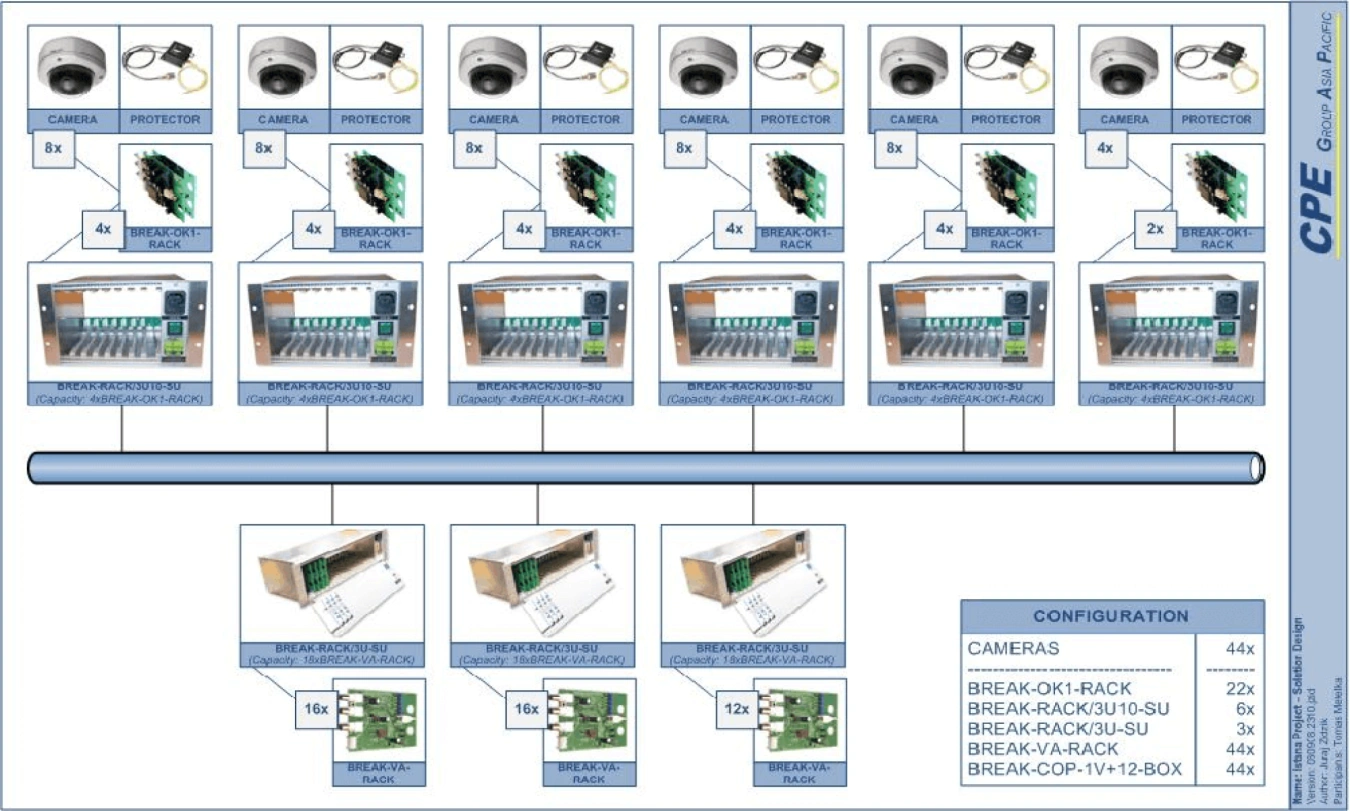
Rescuing a critical investment: thanks to our correction elements, 1.8 km of cable routes (for a total of 135 cameras) did not need to be dug up and re-laid. We saved the customer huge costs in earthworks and new infrastructure.
-
Pushing the boundaries of analogue technology.
-
System immunity "at the core": thanks to integrated surge protectors and galvanic isolation, we solved the problems of tropical storms and differing ground potentials without the need to install additional external components.
-
Eliminating the risk of fatal penalties.
-
Guarantee of a clean image: Removing the ground loops (floating strips) ensured that the surveillance centre received a conclusive and clear image of all 135 cameras, essential for the security of the palace.