

RSTP vs. RSTP-M
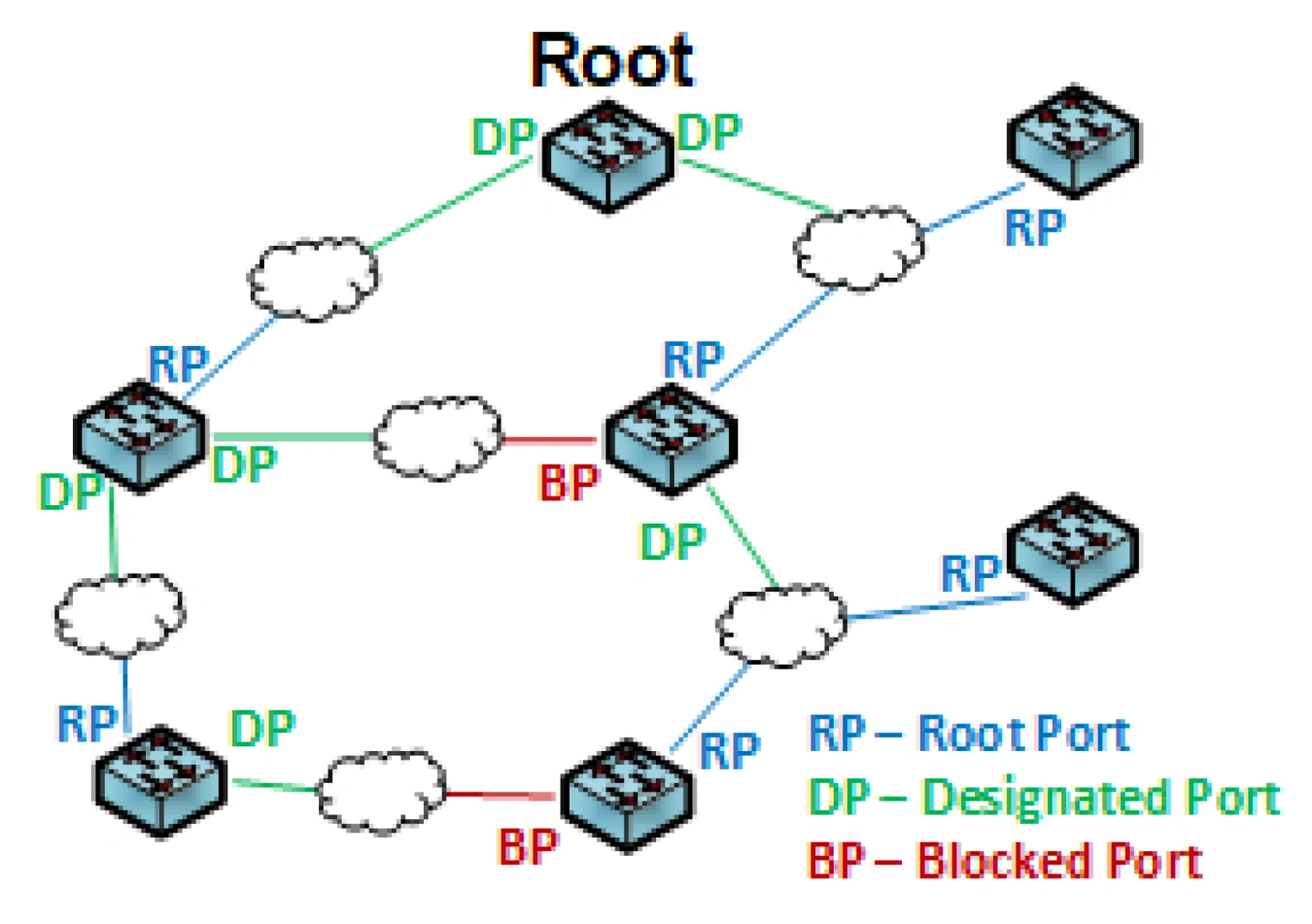
The RSTP-M protocol is a modified version of the RSTP protocol, optimized for use in security and automation systems.
RSTP-M meets the requirements of security and automation systems to quickly provide a backup route in the event of a failure while:
- is fully compatible with RSTP according to IEEE 802.1D-2004
- supports MESH topology
- reduces reconfiguration times to a minimum
- eliminates some of the RSTP's shortcomings. See the examples "Single line outage" and "Loss of ROOT switch"
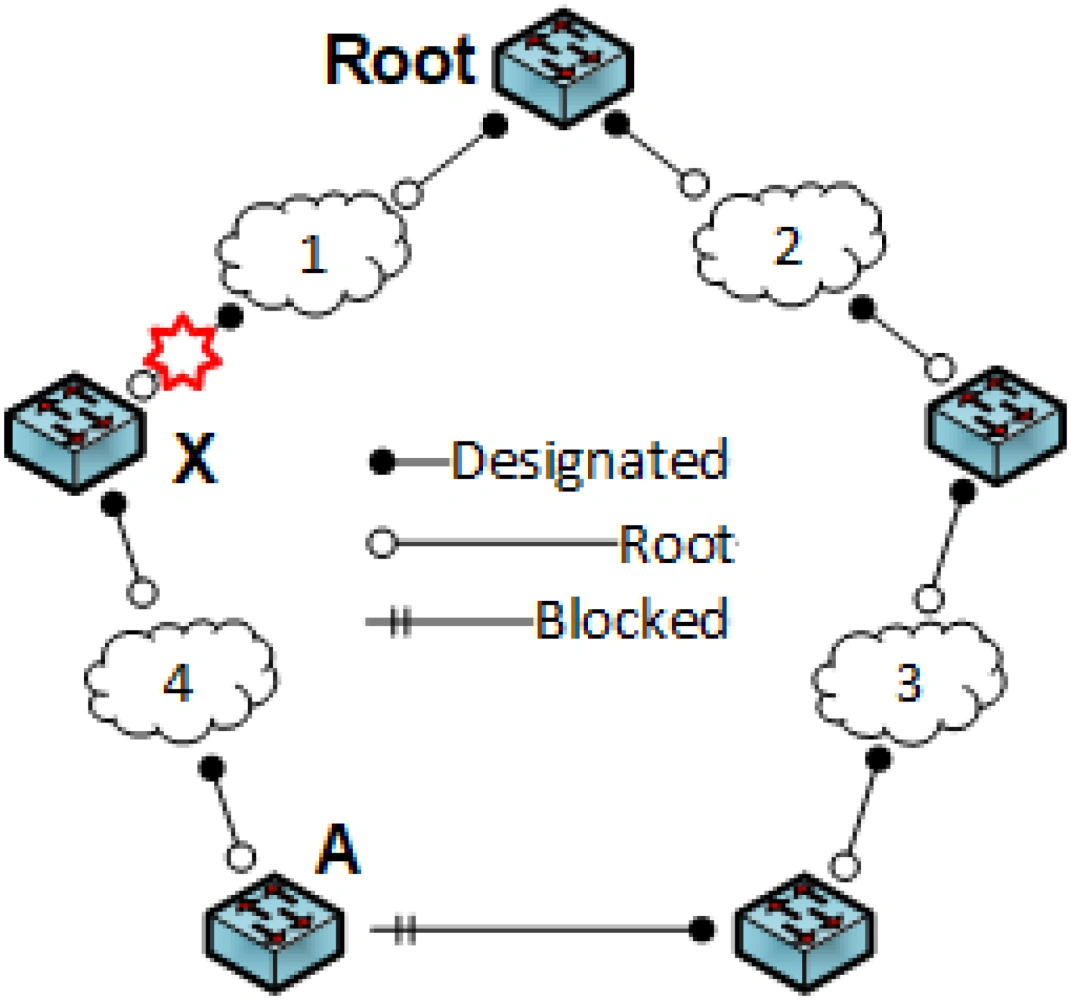
One line outage
At the first failure, the closest switch (X) propagates the path loss information to the active side of the ring. If this information is received by another switch that knows an alternative path (Switch A), it has the task of making it operational.
RSTP: Switch A, after receiving the failure information, waits until it receives a periodic BPDU frame from the alternate path (every 2s by default) to verify the activity of this backup link. Only then does it unblock the alternate path.
RSTP-M: Switch A assumes that the alternate path is active, so it unblocks it immediately.
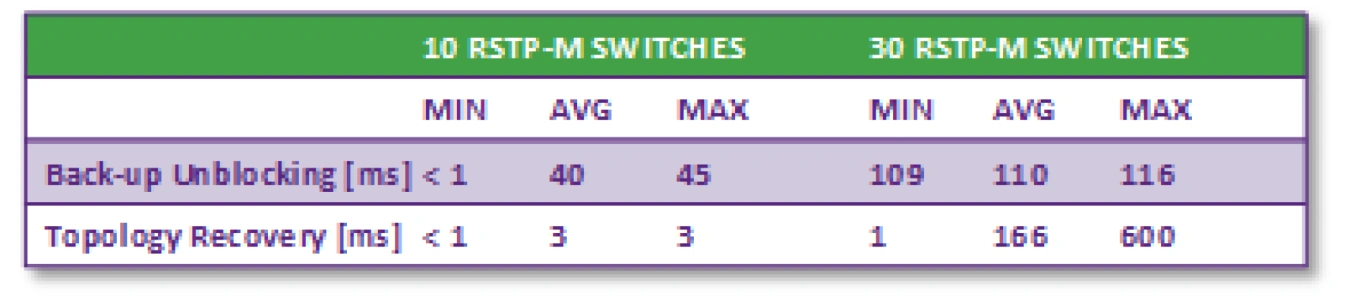
Example of measured values:
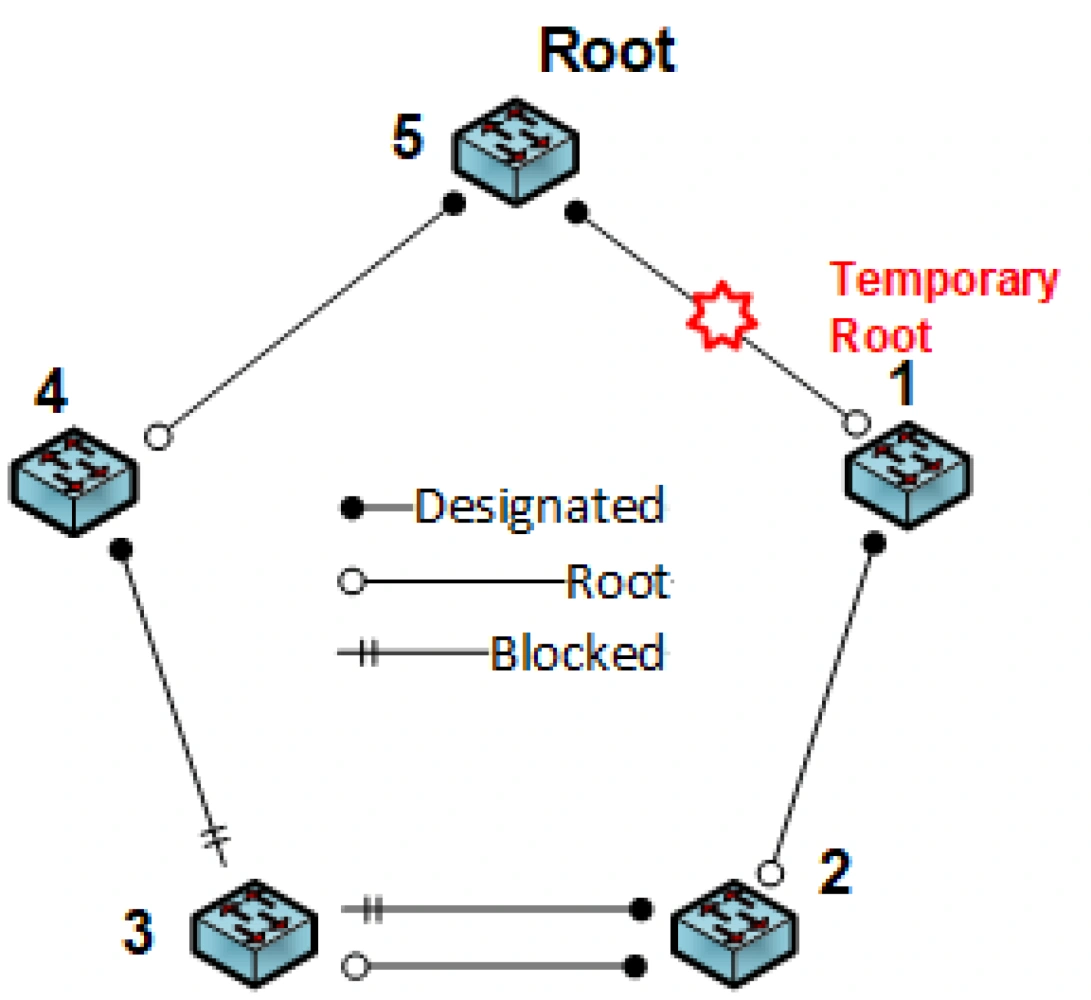
Loss of ROOT switch
If switch 1 loses connectivity to ROOT switch (5), it declares itself (1) as the ROOT switch and propagates the information on to the active side. Switch 3, after receiving the BPDU, starts searching for an alternative path to switch 5.
RSTP: A backup link between switches 2-3 can be evaluated as an alternate path, thus blocking the previously functional link and making the alternate link operational. However, this change does not bring anything,
It will only cause an unwanted data outage. The unblocking of path 3-4 will occur later.
RSTP-M: The protocol actively monitors the state of its immediate neighbours. Based on this information, switch 3 evaluates the change of path 2-3 as useless and the switchover does not occur. Instead, it immediately responds by unblocking path 3-4.
The solutions to these disorders interact with each other. Some implementations of RSTP have addressed the problem of losing the ROOT switch, but take lines because of it when dealing with a link failure. RSTP-M eliminates the delays of both of these and other failures to a minimum.
In security systems, we recommend using a ring topology and LAN-RING protocol to guarantee reconfiguration speed. This is its main advantage compared to RSTP. For systems with more complex topologies, the RSTP-M protocol is a suitable solution. Although it does not guarantee reconfiguration time, it minimizes reconfiguration times compared to the general RSTP protocol. The non-guaranteed network reconfiguration time can cause longer outages (tens of seconds to minutes) of connections to higher-level systems.