
Surge protection of IP CCTV system according to ČSN EN 62305
Lightning strikes to buildings and utilities are dangerous to people, utilities, buildings and their contents. These risks entail the need to set up a set of protective measures. The issue of lightning protection is comprehensively dealt with in the set of standards EN 62305-1 to 4. Among many other areas, it also includes important recommendations for the protection of telecommunication lines. In our applications, this includes protection of UTP/FTP data lines, camera power supplies and data storage devices.
The basis for protection against lightning damage is the calculation of the risk of damage according to EN 62305-2. Based on the risk assessment, the building is classified into one of four lightning protection classes.
Typical classification of buildings into classes:
- LPL I - hospitals, banks, waterworks, power plants including nuclear power plants, explosives depots
- LPL II - schools, supermarkets, weapons depots, cathedrals, GSM transmitters
- LPL III - family houses, agricultural buildings
- LPL IV - buildings without people and internal equipment, buildings with only high-current wiring
The abbreviation LPL stands for "Lightning Protection Level", which must correspond to the LPS "Lightning Protection System" design.
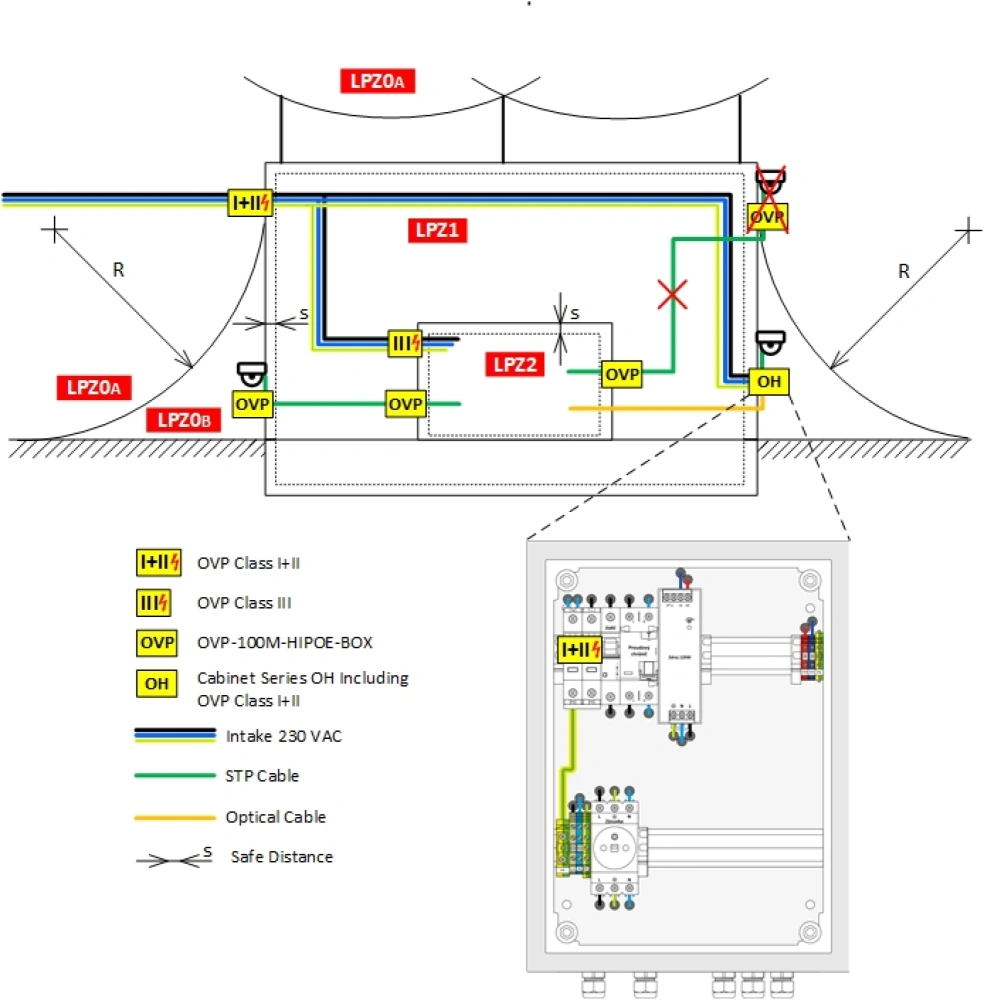
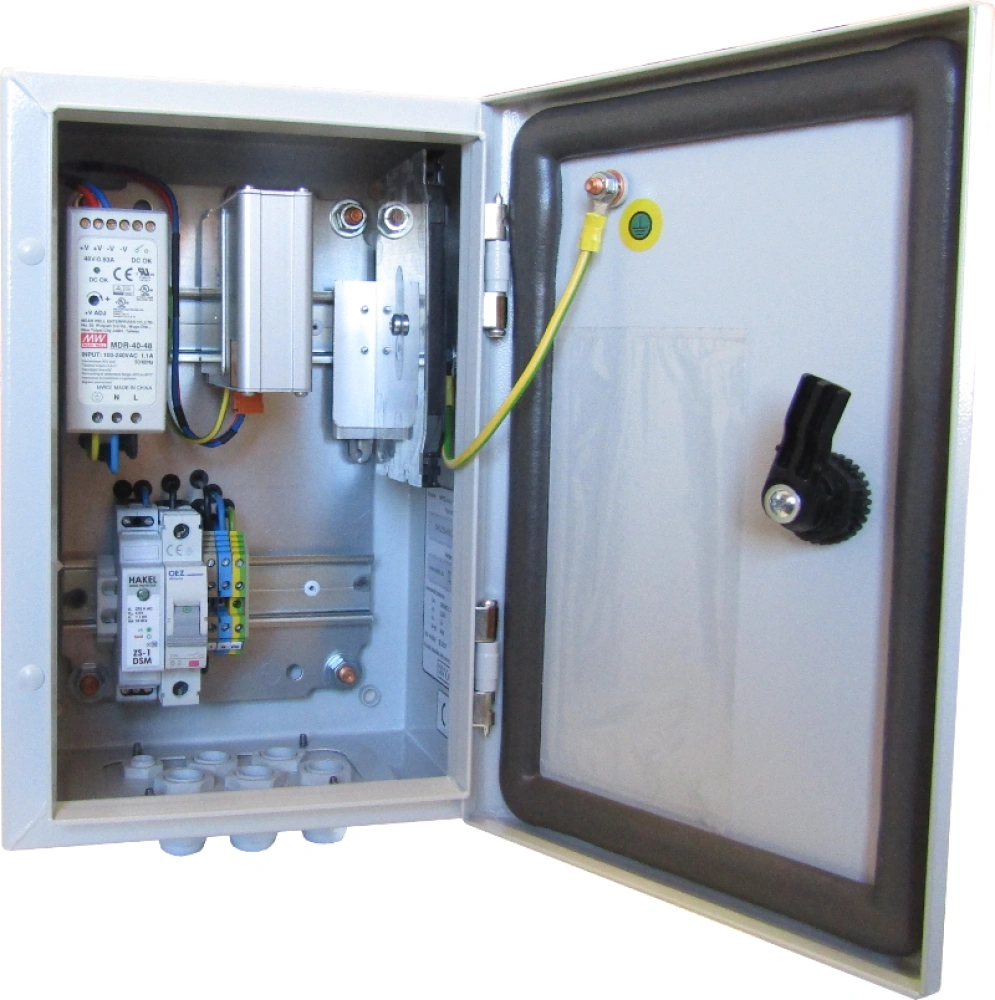
Based on the class classification of the building, it is determined how the lightning protection of the building must be sized. In particular, in applications typical of our facilities, it is necessary to ensure that the protected system is installed within LPZ 1 or higher (EN 62305-1, paragraph 8.4.2). This is achieved by installing switches, PLCs and IO modules in steel switchgear of the OH4320, OH6425, OH8625 series. The switchgear itself can be installed in zone LPZ0B.
The most typical installation methods of our devices are described below for easy comprehension of this text.
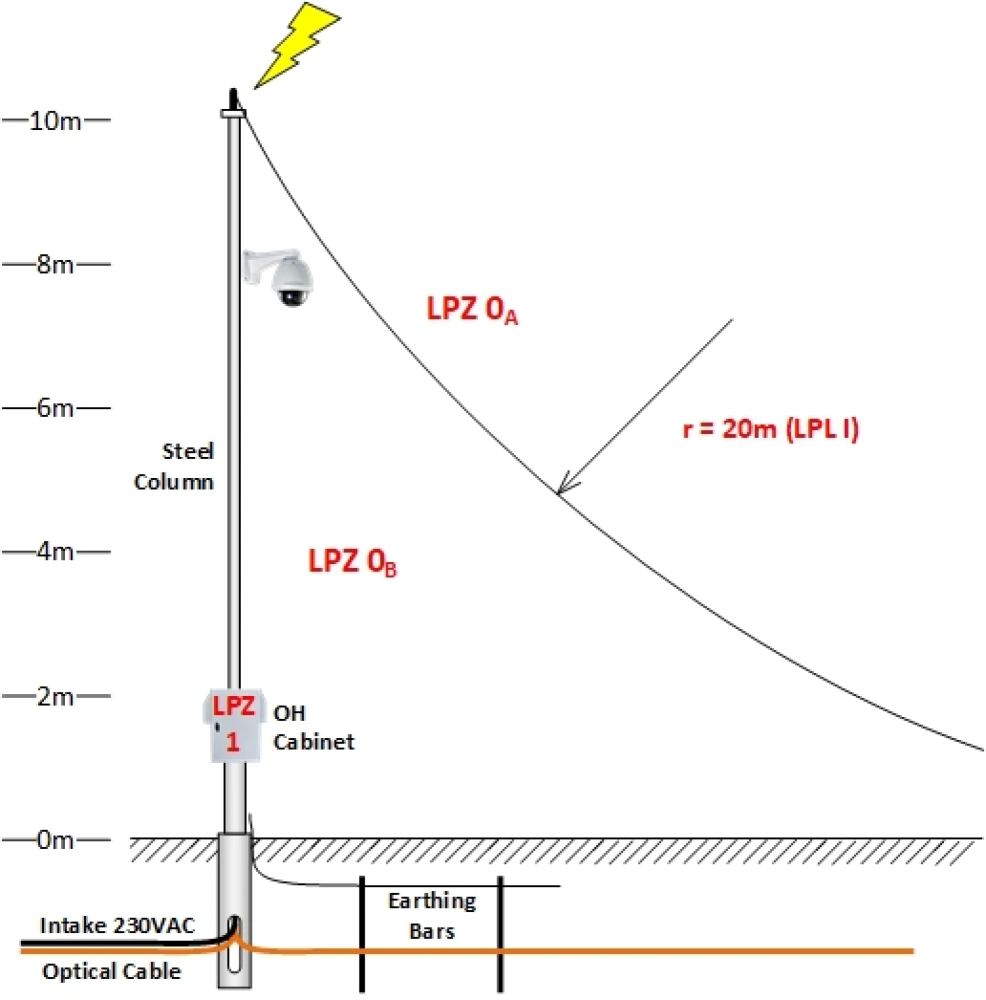
Pole-mounted PoE camera
When installing on stand-alone poles, the biggest challenge is probably to meet the above mentioned requirement to install the protected system inside the LPZ 1 zone.
| Surge protectors in OH switchboards | EN62305-1 ed 2 | |
| 230 VAC supply | 12,5kA waveform 10/350µs | 10kA waveform 10/350µs (Table E.2) |
| Camera cable |
1kA waveform 8/20µs |
0.16kA waveform 8/20µs (Table E.3) for indirect impact on the structure. |
Another non-negotiable part of the system is the camera and the cable between the camera and the switchboard. Here comes the unsolvable problem of choosing the right type. Why? Especially the cheaper camera models have plastic covers without any protection against electromagnetic fields. In the best case, the camera has a cover made of aluminium alloy, which only protects the electronics against the electric field of the discharge. Surge protectors located in the switchboard do not protect the camera. For this reason, it is advisable to install an OVP-100M-HIPOE (PoE camera) or OVP-100M/24-BOX (24VAC power supply) surge protector in the immediate vicinity of the camera. Use STP cable between the camera and the switchboard. When properly wired, shielding reduces induced surges.
PoE camera installed on the outside of the wall
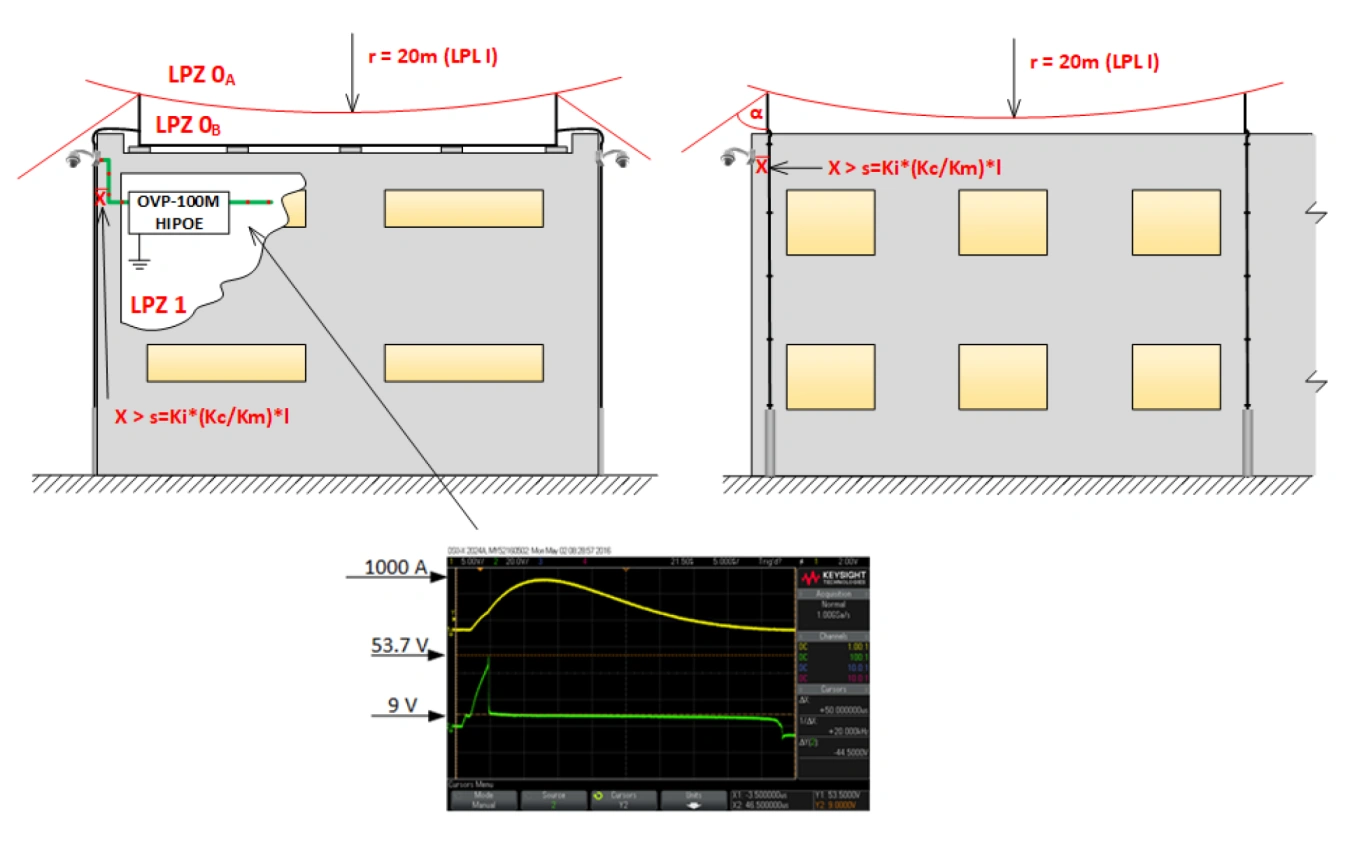
- When designing an IP CCTV system with PoE cameras on the exterior walls of buildings, again pay attention to their correct placement. It is recommended to coordinate the design with a substation designer. He decides on the placement of the arresters and especially the leads, which may interfere with the planned placement of the cameras. In any case, the following principles must be observed in these situations:
The cameras, including feeder cables, must be placed in the LPZ0B zone protected from direct lightning strikes. - The cameras, including feeder cables, must be sufficiently distant from the lightning arresting system.
Use the formula s = Ki*(Kc/Km)*l given in EN 62305-3 ed. 2 to determine the sufficient clearance from the earthing system.
Ki - coefficient dependent on the selected lightning protection class (LPS), see. Table 10 in EN 62305-3 ed. 2,
Kc - coefficient dependent on the current flowing through the leads, see Table 12 in EN 62305-3 ed. 2,
Km - coefficient dependent on the insulation material used, see Table in EN 62305-3 ed. 2,
l - length in metres along the busbar or lead to the nearest point of equipotential bonding. - All metallic cables leading from the camera to the building (LPZ0B to LPZ1 zone interface) shall be protected by suitable surge protectors. We recommend using Table E3 in EN 62305-3 ed. 2 as a guide for selecting a suitable surge protector. It lists the expected currents for different situations. With a correct design of the arresting system and keeping the distance from it, the data cable from the camera is at risk of damage type S4 with a maximum expected current of 160 A (8/20µs) for data cables and 5 kA (8/20µs) for power cables. It is recommended to equip the data cable with OVP-100M-HIPOE surge protector. The surge protector protects all 8 conductors up to 1kA in an 8/20µs wave. Another important detail is the two-stage design of the protection. This ensures that only low residual voltages in data pairs 1-2 and 3-6 reach the output, important for effective protection of connected devices. See the picture below from a test where a pulse of 2kV(1.2/50µs) and 1kV (8/20µs) was applied between conductors 1-2.
An even better solution is to replace metallic data cables with fiber optic cables. Directly to the cameras we recommend installing miniature media converters 200M-1S.0.1-BOX-PoE with integrated surge protectors 1kA in wave 8/20µs. In this case, we can offer the supply of media converters including switchgear of the OH3215 or OH4320 series. The switchgear is certified and manufactured according to the requirements of ČSN EN 61439-1. They include, depending on the selected type, surge protectors of III or I+II level.
Server room
It is recommended to install particularly important equipment in the server room falling into LPZ 2. It is advisable to separate the server room from the surrounding area by a spatial shielding connected to the grounding system of the building, to install surge protectors of III degree at the interface with the LPZ 1 zone and to cover the floor with an electrostatically conductive covering. Based on long-term experience, we do not recommend connecting LPZ 2 to LPZ 0 with metallic data cables, even if they are fitted with surge protectors.