

Redundant topology
Ensuring continuity of data flows is a critical element in modern cybersecurity. The LAN-RING system uses advanced software mechanisms to eliminate outages and quickly reconfigure the network in the event of physical route damage.
LAN-RING Series Protocols (Circular Topologies)
Proprietary protocols optimized for maximum switching speed to the backup route.
-
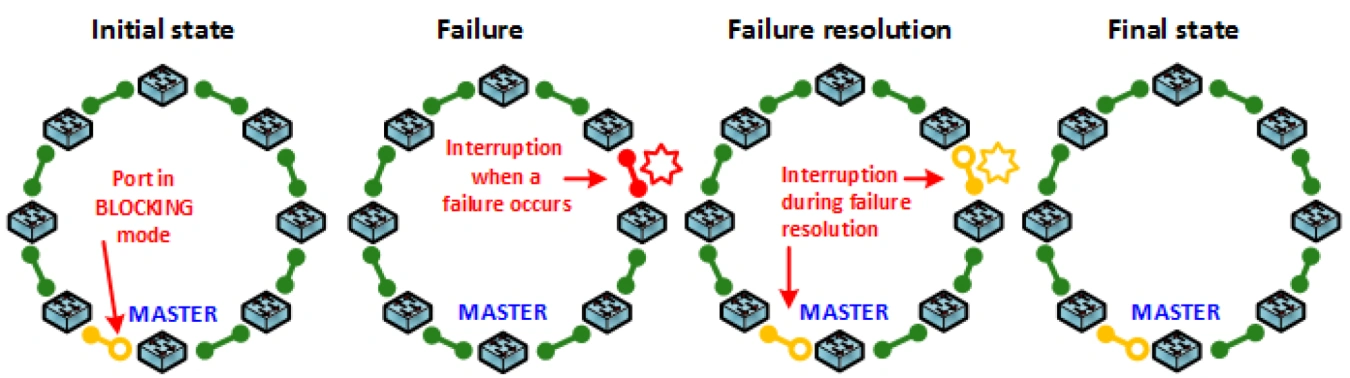
LAN-RING.v1 - A proven standard (since 2008) with a switchover time of up to 30 ms. One switch in the MASTER role blocks the backup port, preventing loops. When a failure is detected, the port is immediately unblocked (FORWARDING mode).
-
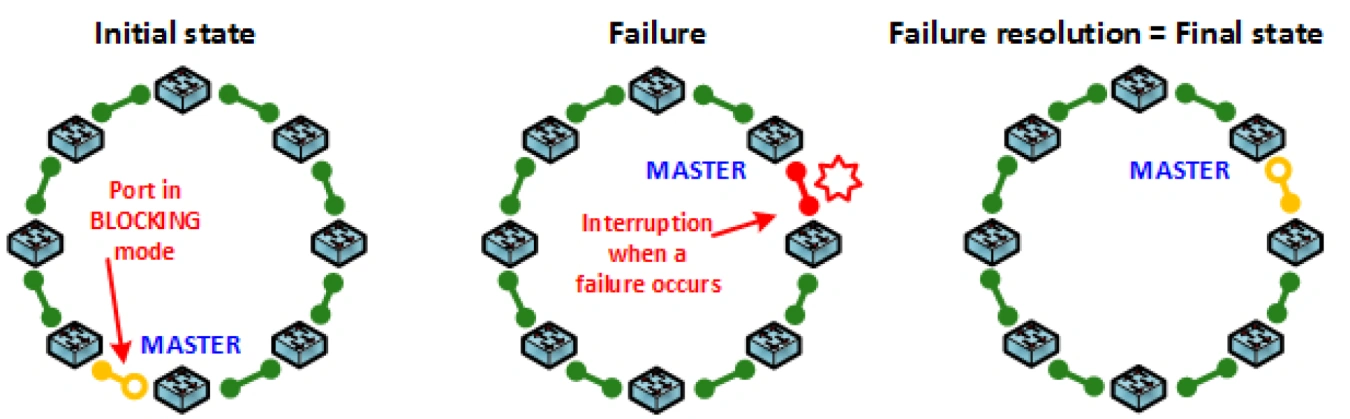
LAN-RING.v2 - Evolutionary version (since 2014) that minimizes the impact on network traffic. Due to the dynamic movement of the MASTER function to the fault location, only one short interruption (max. 30 ms) occurs during the entire cycle (fault generation and fault clearing).
-
Scalability: the performance of LAN-RING protocols is almost independent of the ring size - each switch added increases the reconfiguration time by a negligible 6 μs.
RSTP-M and Mesh topology support
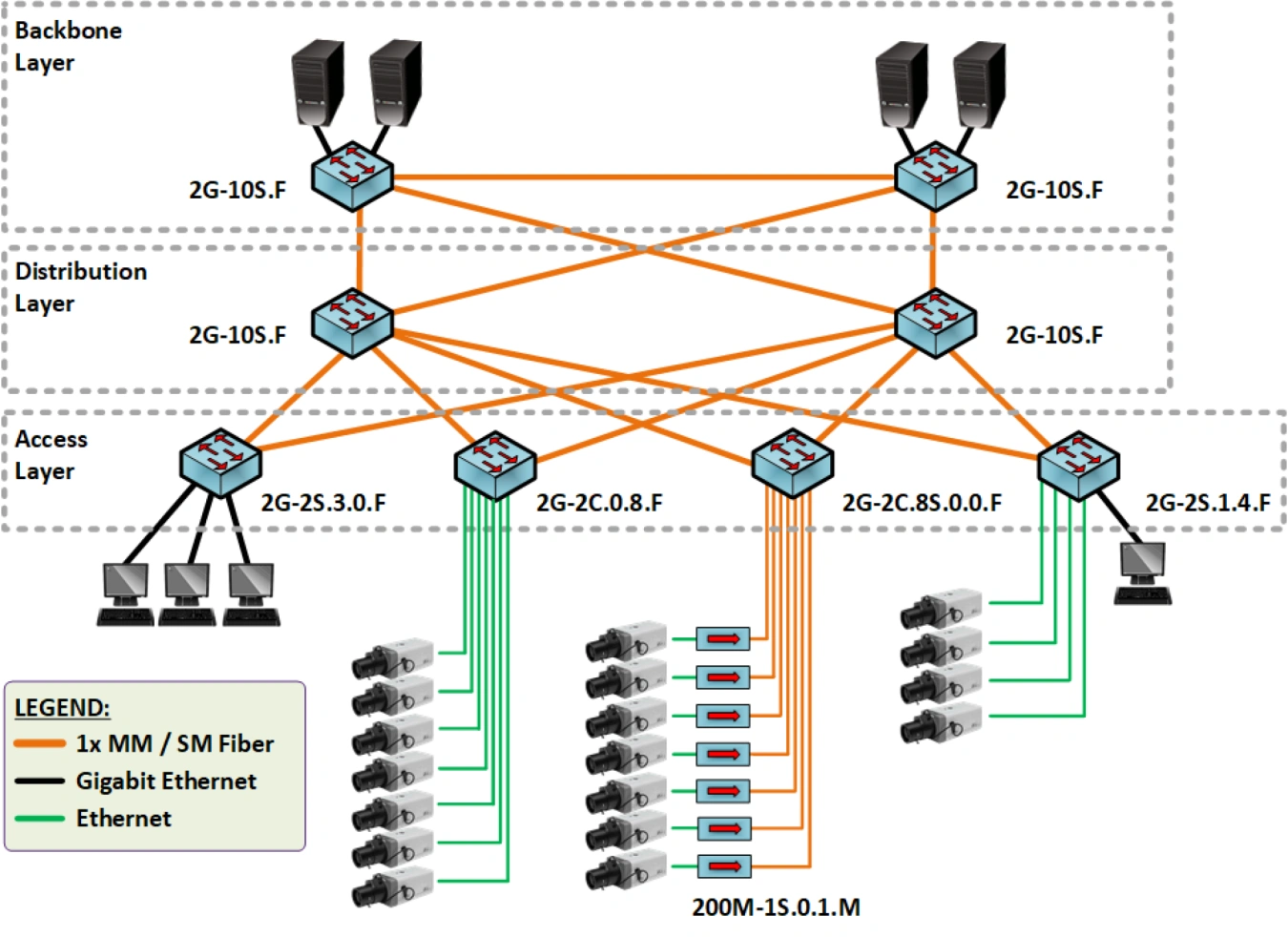
For complex MESH networks where a ring topology is not possible, LAN-RING 3rd generation switches use the optimized RSTP-M protocol.
-
Enhanced standard - RSTP-M eliminates common imperfections in the standard RSTP protocol that often led to seconds-long outages.
-
Compatibility - The protocol is fully backward compatible with the IEEE 802.1D/w standard, enabling deployment in heterogeneous networks.
Link Aggregation (LACP)
In addition to the above topology management protocols, LAN-RING G-Series switches also support the Link Aggregation Control Protocol (LACP) standard of IEEE 802.3ad. This allows:
-
Increase throughput by linking multiple ports in parallel to a single logical channel.
-
Hardware redundancy - When one of the cables in the aggregated bundle fails, the other links take over without any interruption of the connection.