

Island systems
Small off-grid solutions are no longer available in our offer. We focus on what we are strongest at:
Professional optimization and management of photovoltaic power plants and large-scale batteries.
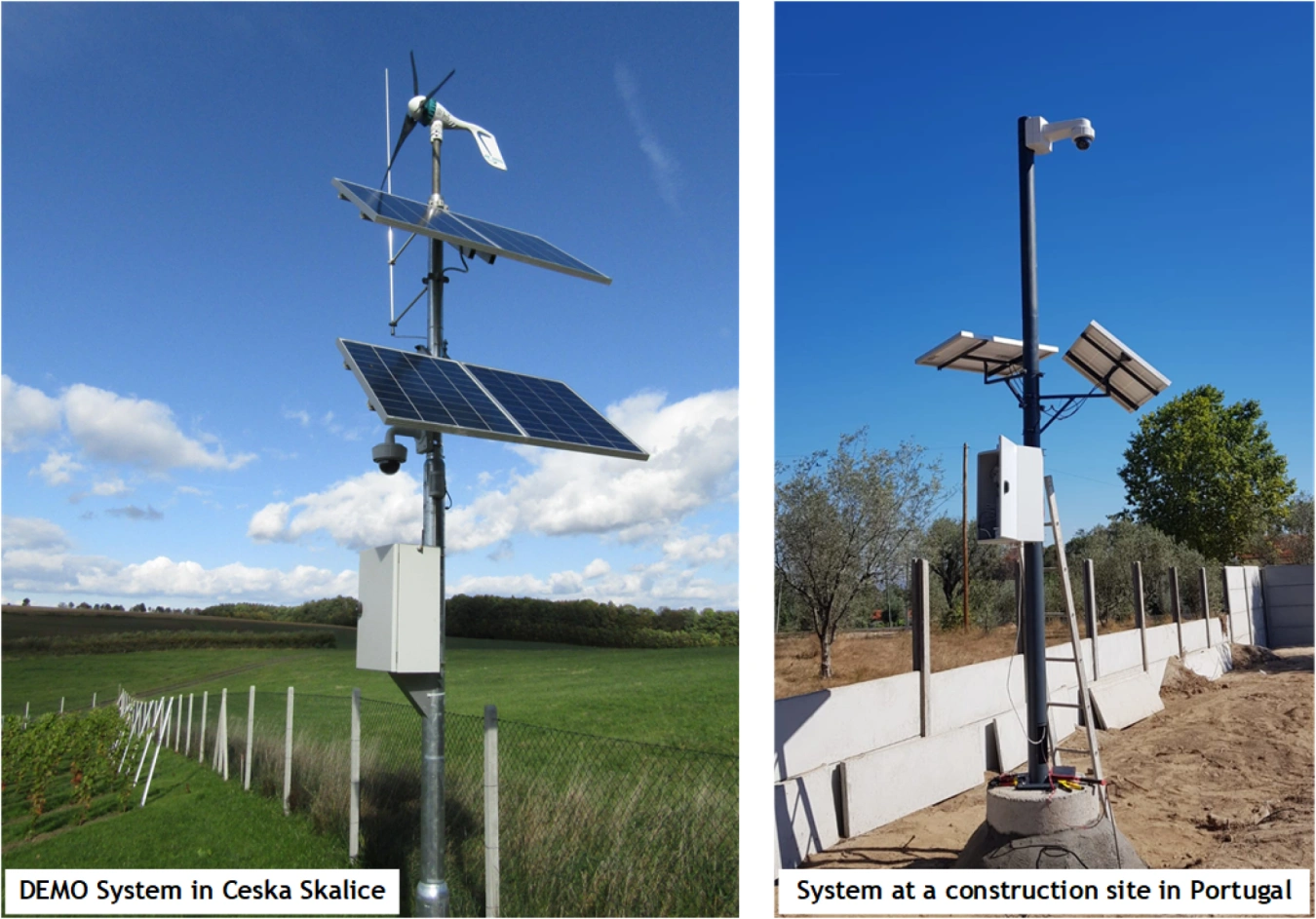
Island systems are designed to help people function without grid support. They use solar and wind energy to power, monitor and control systems in remote areas such as buildings, farm buildings, national borders and dangerous stretches of road, etc.
Main advantages
- OpenVPN - encrypted data transfer - OpenVPN allows you to connect securely through an encrypted VPN tunnel. VPN server software installed on a virtual server with a public IP address provides a secure private connection to many island systems.
- LINUX - stable open source software - Free operating system with extremely good stability. The user has free access to scripting languages, databases and other free tools. This gives him great freedom in designing his own applications and programs
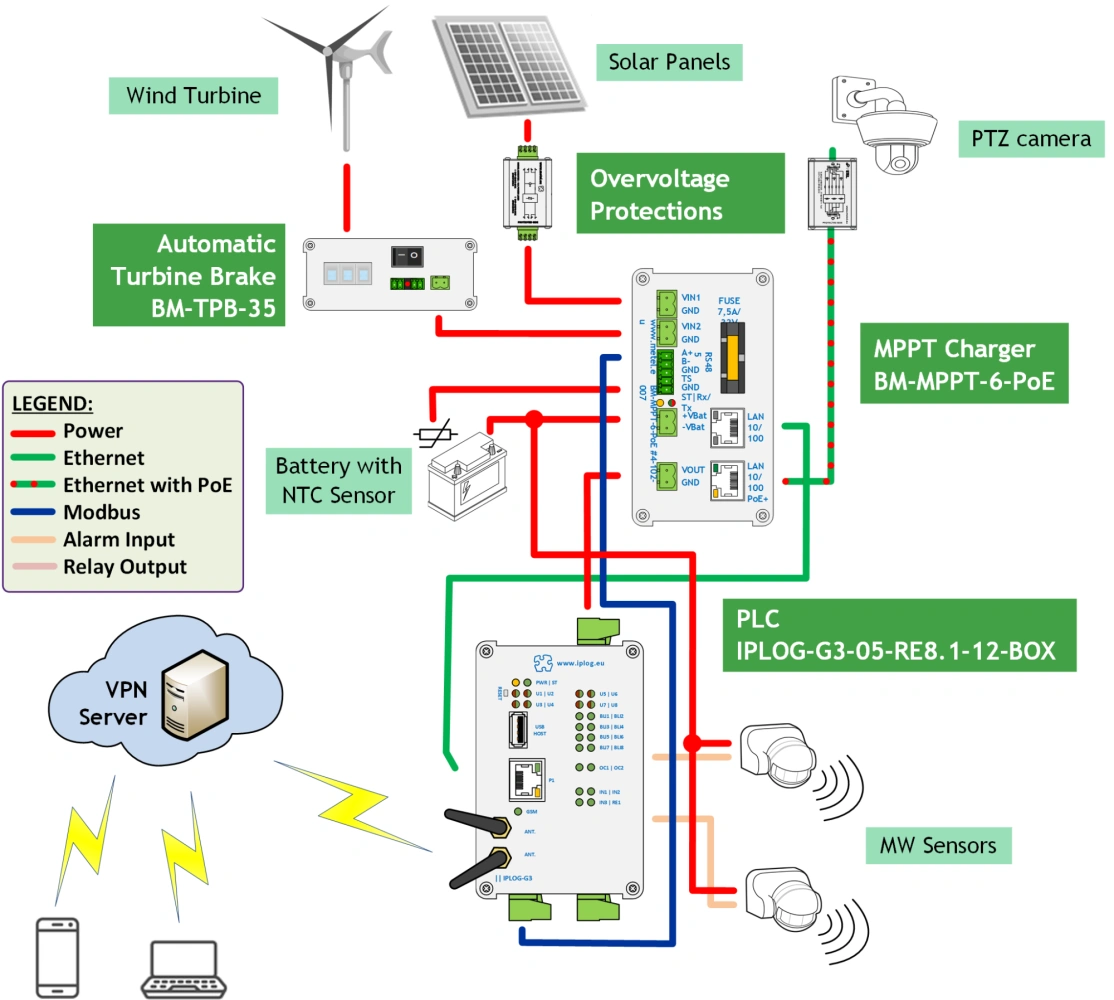
- LAN - IP solution with PoE+ power support - The LAN port allows the user to connect any Ethernet IoT device or for example an IP camera including its PoE power supply from the PoE injector integrated into the MPPT charger.
- COM - Modbus interface - The universal Modbus interface can be used to monitor battery charging status, remotely turn on/off a connected PoE camera, or connect IO modules and sensors. Modbus is a standardized communication protocol, so it additionally allows the connection of devices from different manufacturers.
-
GSM - remote access via 2G/3G/4G-LTE - Wireless connectivity over mobile networks is the ideal solution wherever remote access to remote locations is required. It can also be used as a redundant path for alarm transmission in accordance with security standards for high risk premises.
-
FBD & LD - graphical programming languages - In addition, island systems can execute control programs. Typical examples are: alarm systems for remote site security, data collection from weather stations, control of water pumping from boreholes. All are programmed in graphical interface software with hundreds of supported functions.
-
I & O - large selection of supported inputs and outputs - The IPLOG-GAMA control unit system includes IO modules with various types of digital and analogue inputs and outputs. The IO modules can be part of the control unit or supplied as separate IO modules with Modbus interface.
How did it start?
The idea that led me to develop the island (OFF-GRID) system came while establishing a vineyard in a remote location with no available electricity. The biggest challenge was the development of the MPPT charger. The main problem was that we decided to connect the charger with a PoE+ injector and a Modbus interface to control and monitor the charger. We also didn't want to increase its size too much with a large passive heatsink. Therefore, we first focused on maximizing design efficiency and replaced the large heat sink with a small fan controlled by a microprocessor. The microprocessor measures the temperature of the charger and activates the fan if the temperature is too high. At the same time, the processor measures other operating variables such as charging current, battery voltage, current from the photovoltaic panels, etc. The control PLC stores the measured values in a database and displays them online on a web page if necessary. At the beginning of the 24/7 tests we used a PLC with a 2G/3G modem, which we later replaced with a final version that also supports 4G-LTE networks. A huge advantage of the PLC used is the large variability of inputs and outputs. In the DEMO system, for example, we used alarm inputs to which we connected microwave sensors covering the vineyard area and a tamper to detect the opening of the switchboard with the PLC. In the event of an alarm, the PLC sends SMS to preset numbers and automatically turns on the PoE power to the camera. I can check the vineyard remotely at any time via VMS clients on my mobile phone and computer. Another task of the PLC is the automatic control of the duck door and, from spring 2019, the control of water pumping from the drilled well.
Written by: Tomáš Metelka
Block diagram of the system
Conclusion
The completed island system has met and exceeded the goals we set before we started development. The system is capable of protecting a remote facility, while executing a control program and providing data to remote users in a secure manner. During a very warm summer and a series of storms, the system also demonstrated its high resilience to extreme weather.
Note to winemakers:
Česká Skalice is of course not a typical wine-growing region. The nearest area is Kuks, about 15 km away. Nevertheless, several thousand vine seedlings have been planted in the Náchod and Trutnov regions in recent years by a number of enthusiasts. For my microvineyard I chose resistant varieties Solaris and Cabernet Cortis, supplied by the company Bílovin from Velké Bílovice.
Examples of the equipment used
| Device | Power consumption [W]* | Note |
|---|---|---|
| IPLOG-G2-05 | 2.2 W | 3G/2G PLC METEL - type used in numerical tests (June) |
| IPLOG-G3-05-RE8.1 | - | 4G/3G/2G PLC METEL - planned deployment in April 2018 |
| BM-MPPT-6-PoE | 1 W | MPPT POE+ injector with: - 2 inputs for PV panel/turbine, - output for ACU - thermal charging compensation. Step-up converter efficiency is 93% at full load. |
| Camera AXIS P142-LE | 12.8 W | consumption including IR illumination.- 4th of July replaced by PTZ camera |
| PTZ camera AXIS P5512-E | 12.5 W | IEEE 802.3 af class.3 - deployed July 4 |
| SIP-3020 | 0,4 W | sensor OPTEX 30 x 20 m |
| SIP-3020/5 | 0.4 W | sensor OPTEX 30 x 20 m + built-in detector for suspended ceiling |
| *The values are approximate. | ||
The course of the experiment
| Date | Note | |
|---|---|---|
| April - May 2017 | During this period, major preparations were made including the installation of the pole, lightning rod and earthing. | |
| 5th June | Today we launched the system for the first time with PLC, PoE injector, camera and EVB charging module without protection | |
| 22nd-25th June | The system was tested for 65h using only the battery without recharging. | |
| 29th June | We replaced the temporary EVB final module of the MPPT charger. | |
| 30th June | We have fully functional remote control of the system via SMS and transfer of records to the server. | |
| 30th June | A little trivia: The average GSM signal strength is around -95 dBm. The PLC is usually connected to a transmitter about 15km away with a 2G network. The transmitter in the immediate vicinity (about 3 km) is mostly shaded by a mature forest. |
|
| 4th August | The fixed camera was replaced by a PTZ camera and the battery capacity was increased to 60 Ah. In case of an alarm, the control unit: - rotates the camera through presets, - archives the images to the storage, - sends SMS. |
|
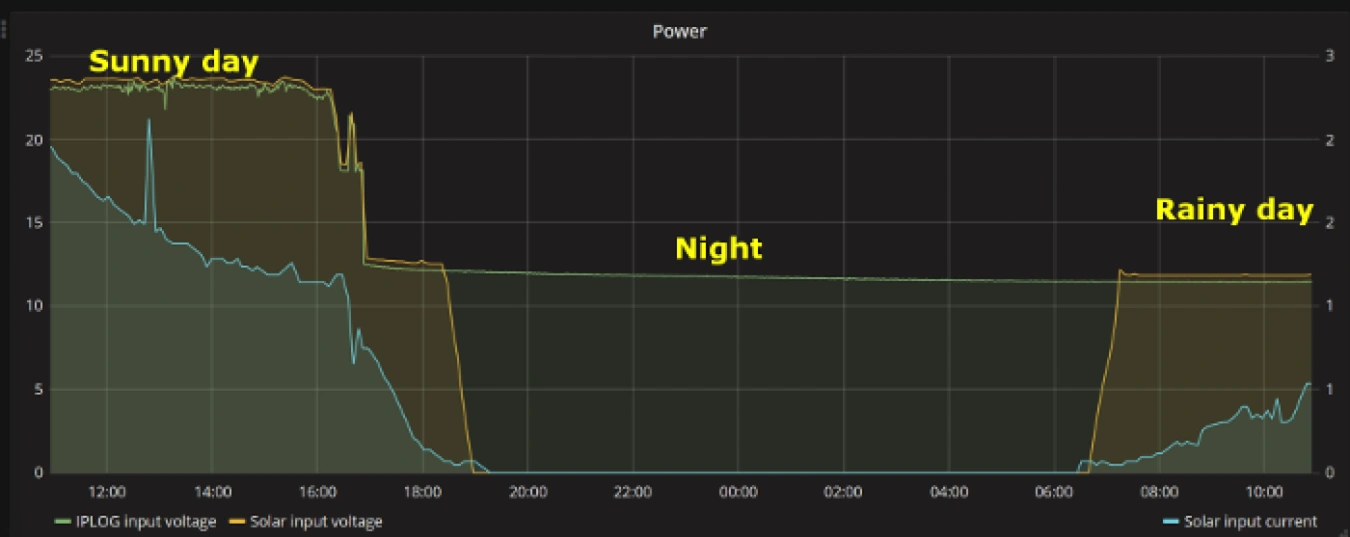
| 28th September | In the first half of September, a significant cooling, clouds and heavy precipitation came to our region. Existing power sources: - Victron 80 Wp solar panel, - Rutland 504 turbine, proved inadequate. We anticipated and prepared for this situation by continuously evaluating the data stored in the database: 1. During days with minimal power supply, we tested the automatic shutdown of the system when the battery voltage dropped below 10V and restarted it. 2. By adding a second 80Wp panel and a more powerful turbine from Ista Breeze, we boosted the power supply. The new propeller starts at wind speeds as low as 2.7 m/s. We plan to add two more 80Wp panels later. |
|
| 2nd October | yellow - PV panel voltage green - IPLOG supply voltage blue - current from PV panel |
 |
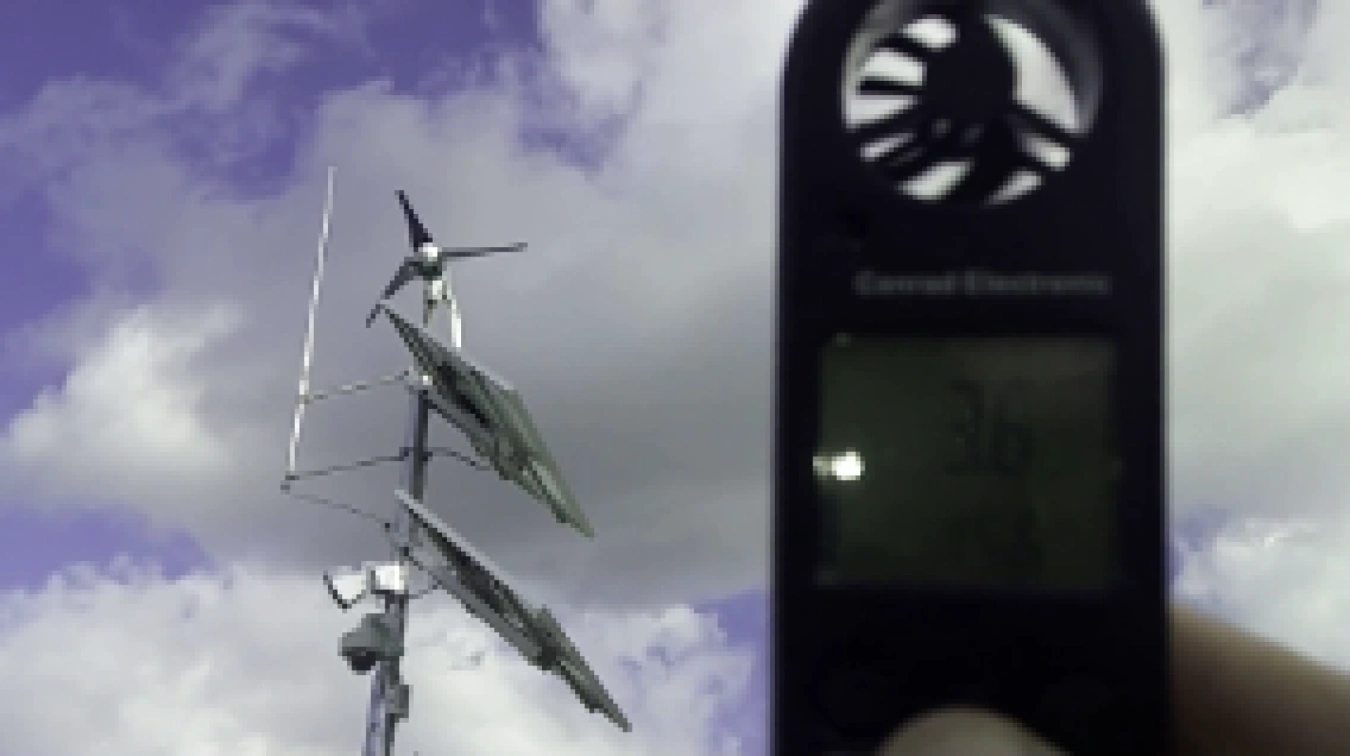
| 6th October | The system is fully equipped in terms of energy resources and includes: - 1x Ista Breeze turbine with a diameter of 1m, - 4x 80Wp panels. The video shows the operation of the turbine during wind gusts ranging from 2 - 7 m/s. |
 |
| 30th October | In the area where the system is installed, we have to take into account several weeks without a sunny day between autumn and spring. That's why we switched the system to energy-saving mode in October. The camera now only starts in the event of an alarm or based on a command from the web interface on a mobile phone or PC. In power saving mode, the power consumption of the system is around 3W. This is enough to fully recharge the system battery even on a cloudy day. | |
| 21st January | Winter weather with temperatures around zero came at the turn of the year. In January, snow fell. The system is still 99% powered by PV panels. wind speeds are only occasionally around 5 m/s, which is the minimum speed required for power generation | 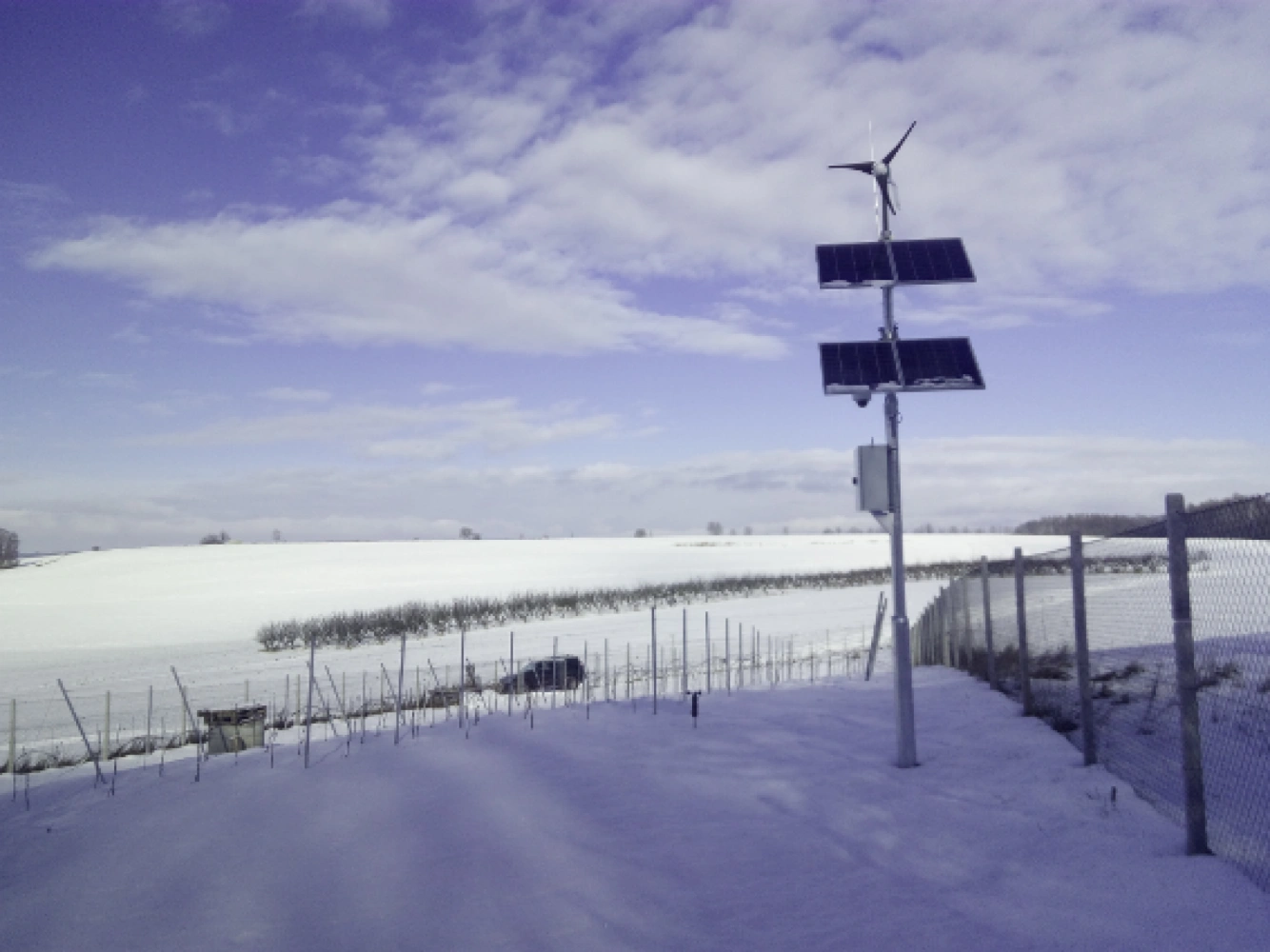 |
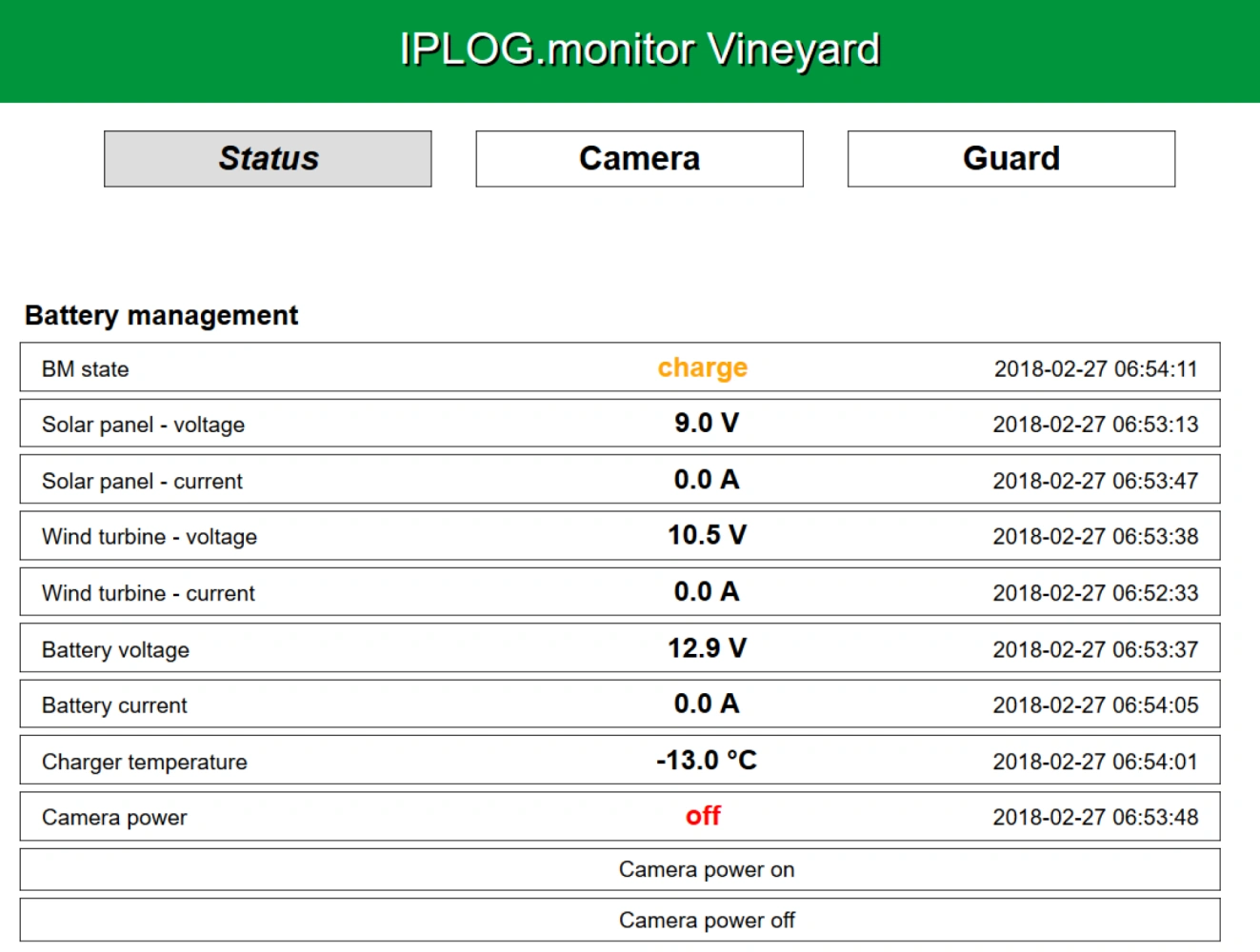
| 27th February |
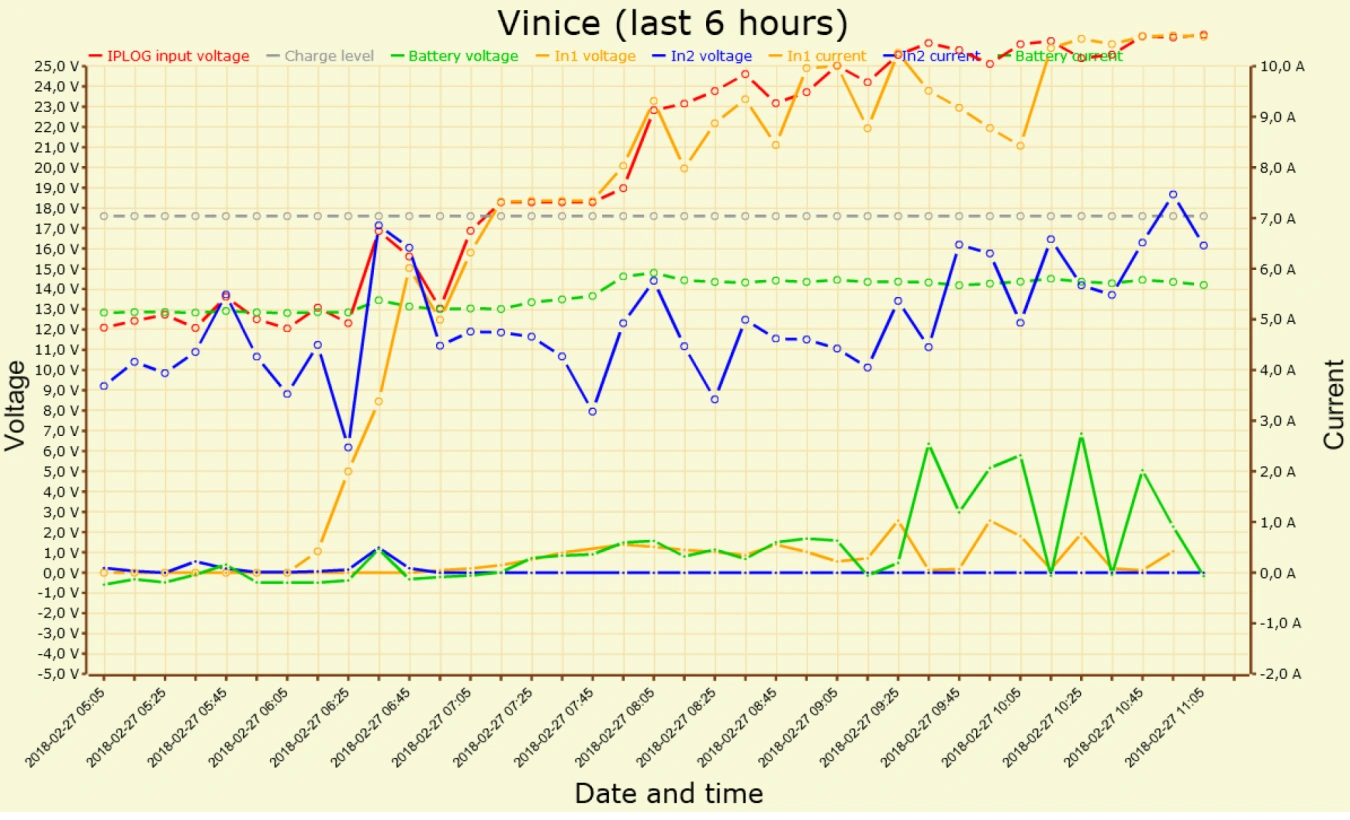
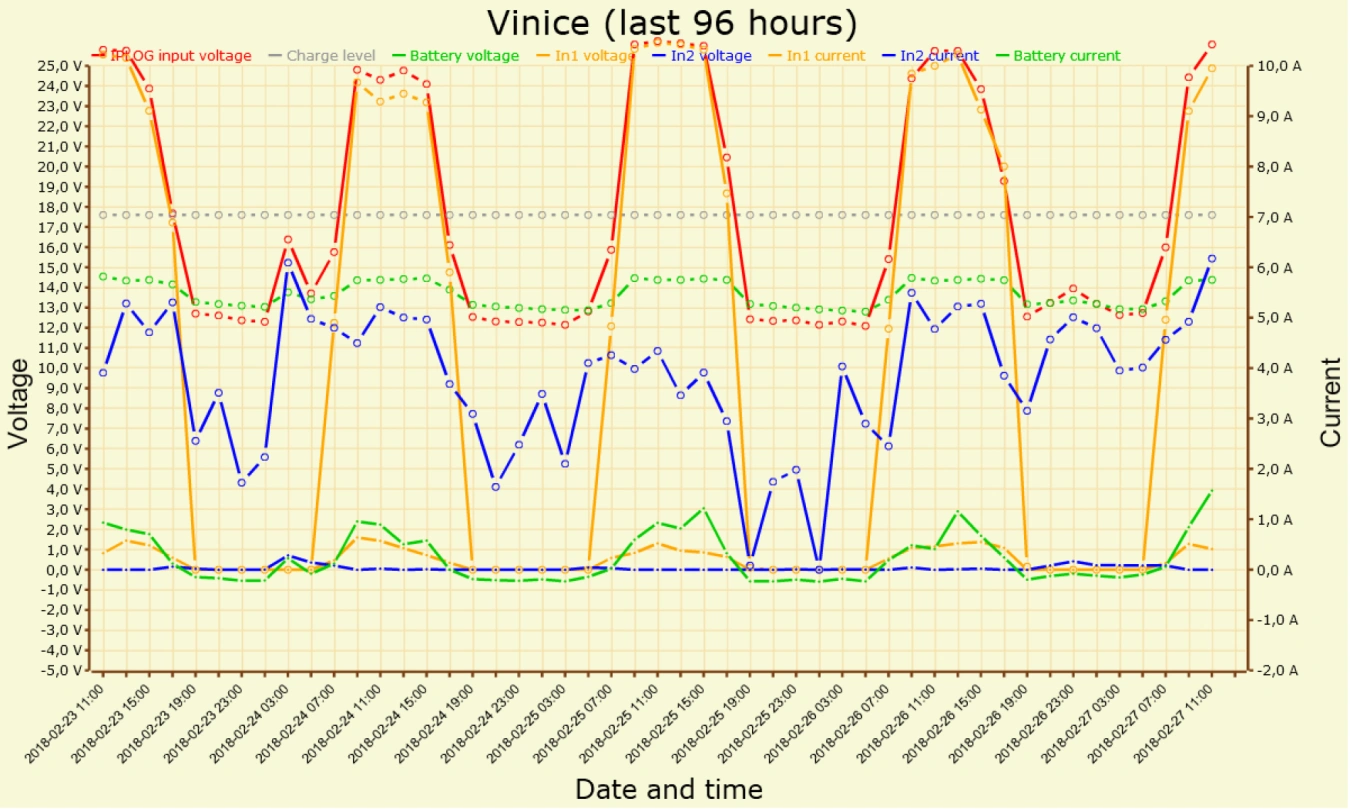
In the second half of February, temperatures dropped to -15°C. The wind started to blow. The attached graphs show it clearly:
|
|
|
|
|
|
| 28 November |
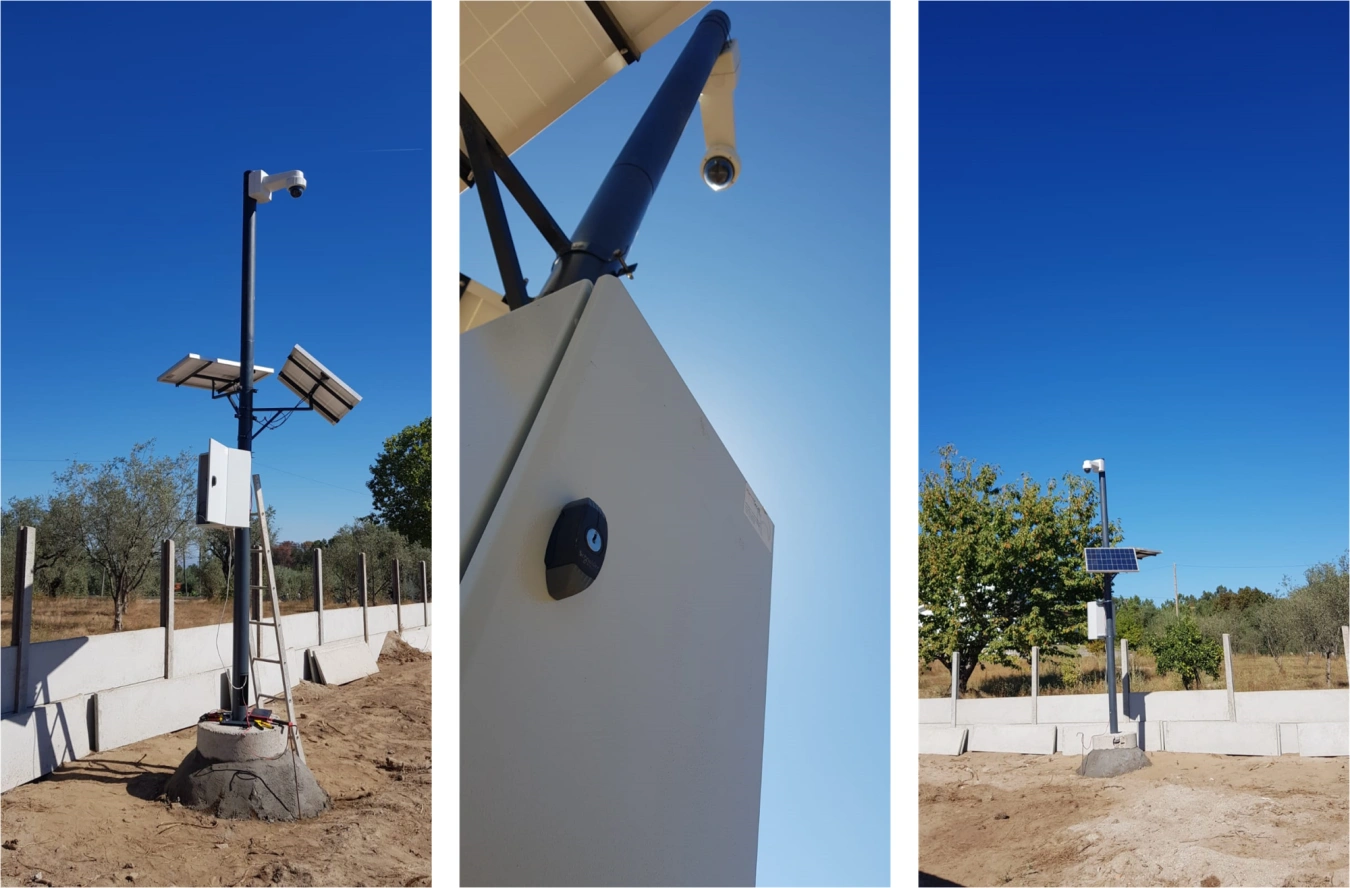
At the end of November 2018, we completed the experimental phase of development. The system is fully functional and ready for deployment. In summer 2018, another demo system was deployed in Portugal for site monitoring. If you have any questions, we would be happy to provide you with detailed information at: info@metel.eu |
|
Indicative prices of the main parts of the system
| Final price in CZK and without VAT | |
| PLC/LTE router IPLOG-GAMA | 15.000 ~ 25.000 |
| OGx distributor including charger and other accessories | 18.000 ~ 29.000 |
| Standalone MPPT charger (without/with injector) | 5.000 ~ 9.000 |
| Solar panels Victron Bluesolar 4 x 80 Wp | < 10.000 |
| Air Speed 12V iSta Breeze turbine | < 10.000 |
| GEL battery 60 Ah Victron | 4.000 |
| Pole | < 10.000 |
| Lightning conductor and earthing | < 5.000 |
| Outdoor sensor OPTEX | 16.000 |