
xDW - minimum requirements for optical path quality
Below you will find an overview of the minimum optical path quality requirements for xDW series optical converters. Failure to meet these requirements can result in a significant reduction in communication quality.
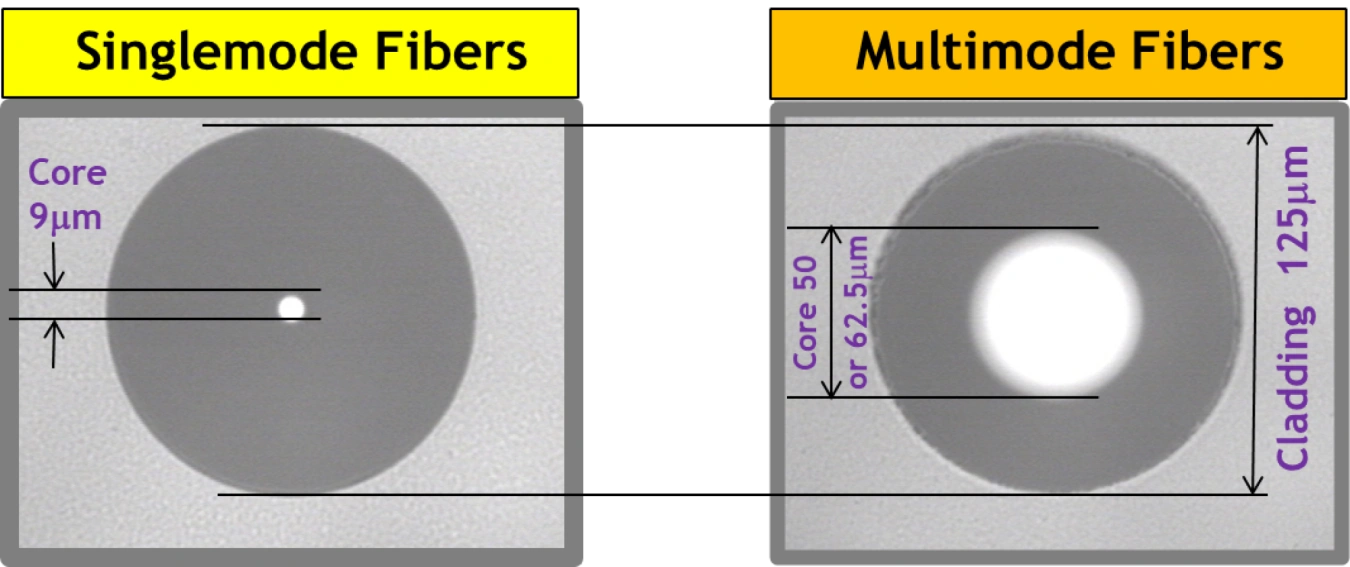
Supported optical fiber types
| Type | Core/sheath diameter | Type |
TDW |
RDW |
| Multimode | 50/125 µm | OM2-4* | Compatible | compatible |
| 62.5/125 µm | OM1* | compatible | compatible | |
| Single-mode | 9/125 µm | OS2 | compatible | compatible |
| * Particularly for OM1 and OM2 types, consider the bandwidth, which is limiting for transmission over longer distances. See section Bandwidth. | ||||
Optical fibre bandwidth
The bandwidth specified in MHz/1km limits usability, especially for older OM1 and OM2 multimode fibre types. The following table shows the maximum ranges for different data rates and fibre types.
| Ethernet |
OM1 - 62,5/125µm multimode |
OM2 - 50/125µm multimode |
OM3 - 50/125µm multimode |
OM4 - 50/125µm multimode |
OS2 - 50/125µm single-mode cable |
| 100Mbps* | 2000m | 2000m | 5000m | 5000m | 20km |
| 1Gbps | 550m | 550m | 1000m | 2000m | 20/60km |
| 10Gb/s | 300m | 300m | 300m | 300m | 20km |
* Communication speed between TDW and RDW converters is close to 100Mb/s.
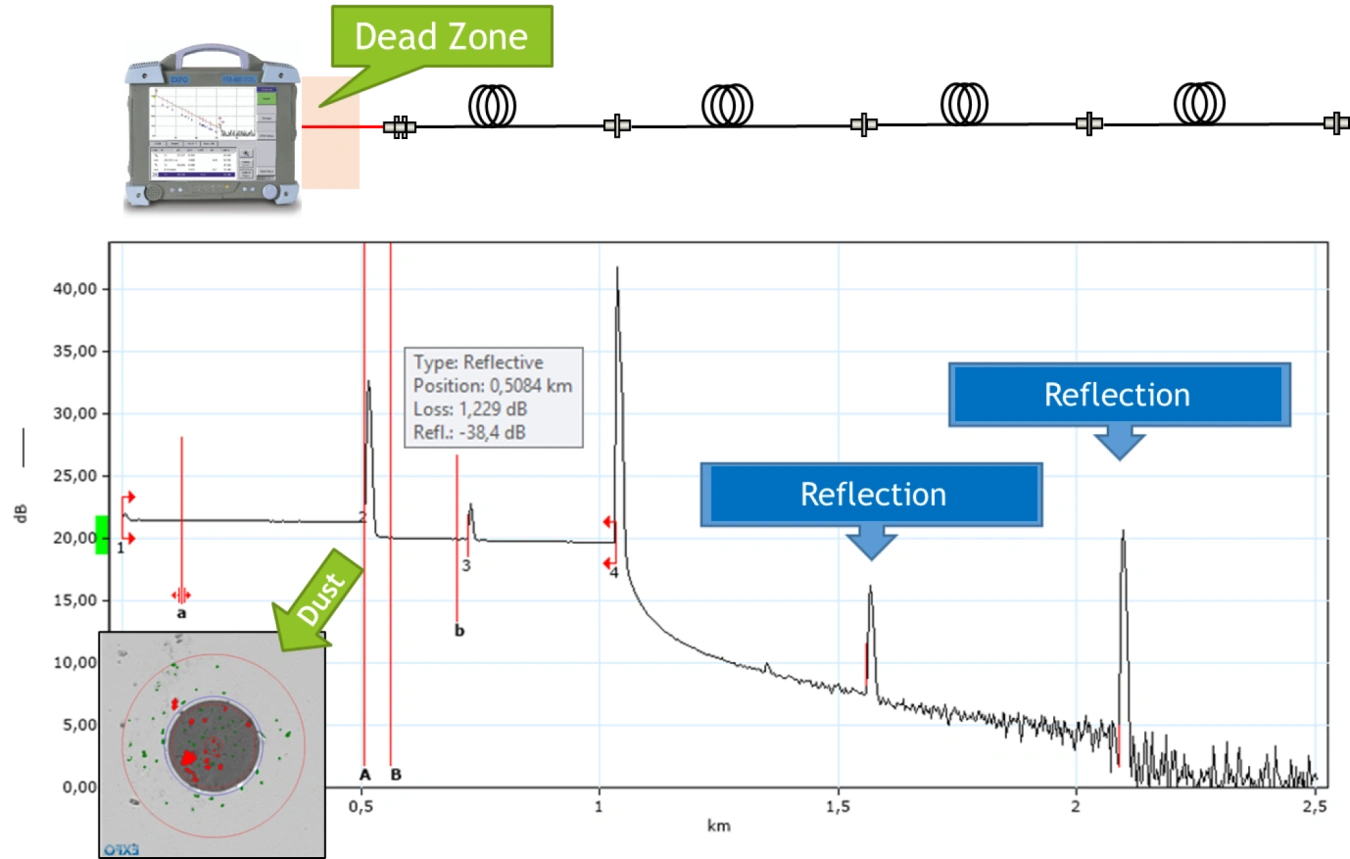
OTDR - attenuation of reflections in joints and welds
Before installing optical converters, we recommend measuring all optical paths using the OTDR method. Measurements should be taken from both sides and with the fiber forward to eliminate the dead zone of the OTDR analyzer. Measurements using this method will provide information on:
- the total attenuation of the optical path,
- the attenuation of all welds, splices and other joints,
- the exact location of all welds, splices and any faults along the route,
- the optical fibre attenuation and its distribution along the route,
- the length of the route,
- fibre inhomogeneity,
- continuity of routes to verify correct installation.
NOTE: Poorly attenuated reflections have a significant effect on the function of the installed optical sensors. In the event of a claim due to link failures, communication bottlenecks, high error rates and similar causes, we reserve the right to resolve the claim upon submission of OTDR reports for the fiber optic routes used. This measure is intended to expedite the resolution of the claim, as in the vast majority of cases with the above causes, the cause is reflections in the optical paths.
| Recommended minimum values of the attenuation of reflections (ORL) for SM fibres | |
| Straight grind connector (PC) | 40 to 50 dB |
| Angled grind connector (APC) | 60 to 70 dB |